


Page 3 - SD 2304
P. 3
mV/SCE
                                               Pitting potential versus temperature
                                       1000     obtained by polarisation curves                             °F

                                       750       SD 2304

                                       500                NaCl 30 g/l
                                              316L
                                       250
                                             304L
                                                                                  304L      316L     SD 2304
                                                                                   Guaranteed
                                                  25     50     75   °C
                                                  75    120     165   °F

                                           Stress corrosion resistance

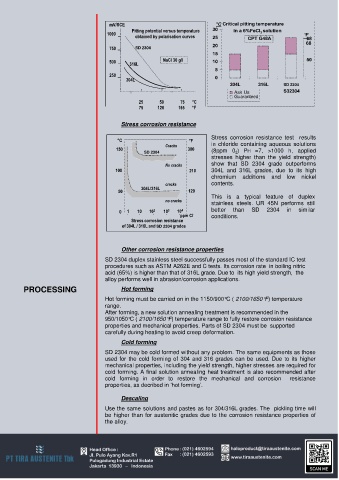
                                                                           Stress  corrosion  resistance  test    results

                                                           Cracks          in  chloride  containing  aqueous  solutions
                                                                           (8ppm  0 2 )  PH  =7,  >1000  h,  applied
                                                    SD 2304
                                                                           stresses  higher  than  the  yield  strength)
                                                           No cracks       show  that  SD  2304  grade  outperforms
                                                                           304L  and  316L  grades,  due  to  its  high
                                                                           chromium  additions  and  low  nickel
                                                           cracks          contents.

                                                                           This  is  a  typical  feature  of  duplex
                                                           no cracks
                                                                           stainless  steels.  UR  45N  performs  still
                                                                10   4     better   than   SD   2304   in   similar
                                                                ppm Cl   -  conditions.

                                                        SD 2304


                                            Other corrosion resistance properties
                                      SD 2304 duplex stainless steel successfully passes most of the standard IC test
                                      procedures such as ASTM A262E and C tests. Its corrosion rate  in boiling nitric
                                      acid (65%) is higher than that of 316L grade. Due to  its high yield strength,  the
                                      alloy performs well in abrasion/corrosion applications.
         PROCESSING                         Hot forming

                                      Hot forming must be carried on in the 1150/900°C ( 2100/1650°F) temperature
                                      range.
                                      After forming, a new solution annealing treatment is recommended in the
                                      950/1050°C ( 2100/1650°F) temperature range to fully restore corrosion resistance
                                      properties and mechanical properties. Parts of SD 2304 must be  supported
                                      carefully during heating to avoid creep deformation.
                                            Cold forming
                                      SD 2304 may be cold formed without any problem. The same equipments as those
                                      used for  the  cold  forming  of  304 and 316 grades  can  be  used. Due to  its  higher
                                      mechanical properties, including the yield strength, higher stresses are required for
                                      cold forming. A final solution annealing heat treatment is also recommended after
                                      cold  forming  in  order  to  restore  the  mechanical  and  corrosion    resistance
                                      properties, as decribed in ‘hot forming’.

                                            Descaling
                                      Use the same solutions and pastes as for 304/316L grades. The  pickling time will
                                      be higher than for austenitic grades due to the corrosion resistance properties of
                                      the alloy.

