


Page 3 - SH 310
P. 3
3
Low oxygen atmosphere containing atmospheres with a maximum 2 g/m
sulphur content: 1000° C (1832°F) maximum.
3
Low oxygen atmosphere with a sulphur content higher than 2 g/m : 750°C
(1382°F) maximum.
Nitriding or carburizing atmospheres : 900 to 1000°C (1652 to 1932°F)
maximum.
The alloy is not designed for reducing and nitriding or carburizing atmospheres
where higher nickel contents alloys (SIRIUS 600 or 800 family) are prefered.
Nevertheless, SH 310 performs better in those conditions than most of the heat
resistant stainless steels.
°F 1200 °C °F 2012
1200 2192 1100
SH 310 1832
1100 2012 1000
SIRIUS S12
1000 SIRIUS 309 1832 900 1652
800
900 1652 1472
700
800 321 1472 600 1292
700 Cr+Si 321
18 20 22 24 26 28 SIRIUS S12 SIRIUS 309 SH 310 SIRIUS 314 SIRIUS 800
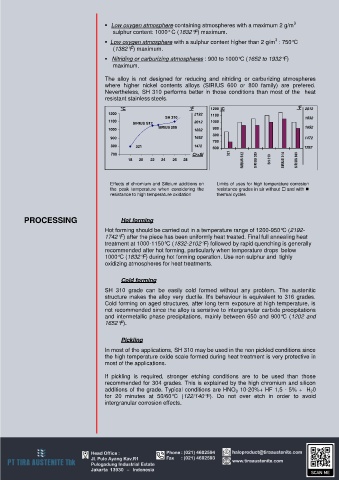
Effects of chromium and Silicium additions on Limits of uses for high temperature corrosion
the peak temperature when considering the resistance grades in air without and with
resistance to high temperature oxidation thermal cycles
PROCESSING Hot forming
Hot forming should be carried out in a temperature range of 1200-950°C (2192-
1742°F) after the piece has been uniformly heat treated. Final full annealing heat
treatment at 1000-1150°C (1832-2102°F) followed by rapid quenching is generally
recommended after hot forming, particularly when temperature drops below
1000°C (1832°F) during hot forming operation. Use non sulphur and tighly
oxidizing atmospheres for heat treatments.
Cold forming
SH 310 grade can be easily cold formed without any problem. The austenitic
structure makes the alloy very ductile. It's behaviour is equivalent to 316 grades.
Cold forming on aged structures, after long term exposure at high temperature, is
not recommended since the alloy is sensitive to intergranular carbide precipitations
and intermetallic phase precipitations, mainly between 650 and 900°C (1202 and
1652°F).
Pickling
In most of the applications, SH 310 may be used in the non pickled conditions since
the high temperature oxide scale formed during heat treatment is very protective in
most of the applications.
If pickling is required, stronger etching conditions are to be used than those
recommended for 304 grades. This is explained by the high chromium and silicon
additions of the grade. Typical conditions are HNO 3 10-20%+ HF 1,5 - 5% + H 2 0
for 20 minutes at 50/60°C (122/140°F). Do not over etch in order to avoid
intergranular corrosion effects.

