


Page 2 - SH 310
P. 2
CREEP Typical creep properties
PROPERTIES °C °F Creep strain (MPa) Creep rupture
600 1112 1000h 10000h 100000h 1000h 10000h 100000h
200
100
140
80
120
40
700 1292 50 35 20 80 45 20
800 1472 20 10 8 35 20 8
1652
3
15
10
900
10
5
6
1000 1832 5 3 1.5 9 4 2
PHYSICAL Interval Thermal Thermal Specific Young Shear
PROPERTIES Temper expansion °C °F Resistivity conductivity heat -1 modulus modulus
G
E
-1
-1
-1
-1
-6
°C
20-100 ax10 K 20 68 (µW cm) (W.m .K ) (J.kg .K ) (GPa) (GPa)
15.5
90
14
200
480
75
20-200 16 200 392 100 16 560 185 70
110
752
20-400
170
17
64
680
18
400
20-600 18 600 1112 120 20 780 155 58
800 1472
20-800
10-1000 18.5 1000 1832 125 22 870 135 53
19
930
120
45
24
130
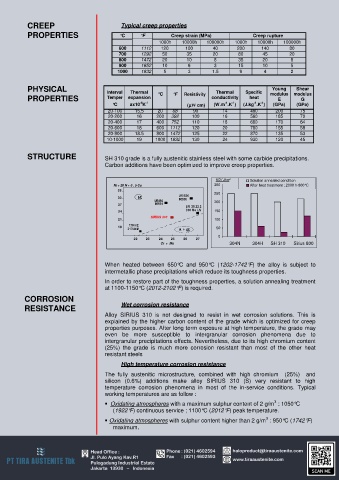
STRUCTURE SH 310 grade is a fully austenitic stainless steel with some carbide precipitations.
Carbon additions have been optimized to improve creep properties.
KCV J/cm² Solution annealed condition
Ni + 20 N + 0 . 5 Cu 300 After heat treatment : 2000 h-800°C
33
UR B26 250
30 08926
UR B6 200
27 08924
UR 25.22.2
310 Mo LN
24 150
SIRIUS 310
21 100
170 HE
18 50
+
22 23 24 25 26 27
Cr + Mo 304N 304H SH 310 Sirius 800
When heated between 650°C and 950°C (1202-1742°F) the alloy is subject to
intermetallic phase precipitations which reduce its toughness properties.
In order to restore part of the toughness properties, a solution annealing treatment
at 1100-1150°C (2012-2102°F) is required.
CORROSION
RESISTANCE Wet corrosion resistance
Alloy SIRIUS 310 is not designed to resist in wet corrosion solutions. This is
explained by the higher carbon content of the grade which is optimized for creep
properties purposes. After long term exposure at high temperature, the grade may
even be more susceptible to intergranular corrosion phenomena due to
intergranular precipitations effects. Nevertheless, due to its high chromium content
(25%) the grade is much more corrosion resistant than most of the other heat
resistant steels
High temperature corrosion resistance
The fully austenitic microstructure, combined with high chromium (25%) and
silicon (0.6%) additions make alloy SIRIUS 310 (S) very resistant to high
temperature corrosion phenomena in most of the in-service conditions. Typical
working temperatures are as follow :
3
Oxidating atmospheres with a maximum sulphur content of 2 g/m : 1050°C
(1922°F) continuous service ; 1100°C (2012°F) peak temperature.
3
Oxidating atmospheres with sulphur content higher than 2 g/m : 950°C (1742°F)
maximum.

